Visit: The New Homepage

Visit: The New Homepage
Kindly click the image for the updated Notes Online

Friday, April 11, 2014

Diode Applications - MCQs Answers

0 comments Posted by Anonymous at 3:05 PM
Hits:
Answers key for  Floyd's Diode Applications
Below are the answers key for the Multiple Choice Questions (Quiz) in Floyd's Diode Applications .

1. 60 Hz

2. 100 Hz

3. reducing the peak output voltage by 0.7 V.

4. line regulation

5. load regulation

6. peak inverse voltage

7. the filter capacitor is shorted.

8. an open transformer secondary.

9. b

10. c

11. d

12. a full-wave rectifier (no filter) with an open diode.

13. c

14. b

15. d

16. a

17. c

18. a

19. forward-biased.

20. equal to

21. forward, 180º

22. twice

23. 2Vp(out) + 0.7 V

24. increasing, increasing

25. clipper or limiter

26. clamper

27. 50 V

28. 3

Back to Homepage


credit: Thomas L. Floyd©2013 www.FroydWess.com

Read More »

Diode Applications - MCQs

0 comments Posted by Anonymous at 2:59 PM
Hits:
MCQs for Floyd's Diode Applications

Multiple Choice Questions Topic Outline

  • MCQs in Diode Operation
  • MCQs in Voltage-Current (V-I) Characteristics of a Diode
  • MCQs in Diode Models
  • MCQs in Half-Wave Rectifiers
  • MCQs in Full-Wave Rectifiers
  • MCQs in Power Supply Filters and Regulators
  • MCQs in Diode Limiters and Clampers
  • MCQs in Voltage Multipliers
  • MCQs in The Diode Datasheet
  • MCQs in GreenTech Application 2: Solar Power

Begin and Good luck!

1. If the ac supply is 60 Hz, what will be the ripple frequency out of the half-wave rectifier?

  • A) 30 Hz
  • B) 50 Hz
  • C) 60 Hz
  • D) 120 Hz

2. If the ac supply is 50 Hz, what will be the ripple frequency out of the full-wave rectifier?

  • A) 50 Hz
  • B) 60 Hz
  • C) 100 Hz
  • D) 120 Hz

3. A silicon diode in a half-wave rectifier has a barrier potential of 0.7 V. This has the effect of

  • A) reducing the peak output voltage by 0.7 V.
  • B) increasing the peak output voltage by 0.7 V.
  • C) reducing the peak input voltage by 0.7 V.
  • D) no effect.

4. In a regulated supply, what term describes how much change occurs in the output voltage for a given change in the input voltage?

  • A) load regulation
  • B) voltage regulator
  • C) line regulation
  • D) ripple voltage

5. In a regulated supply, what term describes how much change occurs in the output voltage over a certain range of load current values, from minimum to maximum current?

  • A) line regulation
  • B) voltage regulator
  • C) current regulator
  • D) load regulation

6. PIV is which of the following?

  • A) peak input voltage
  • B) peak inverse voltage
  • C) peak immediate voltage
  • D) positive input voltage

7. Refer to Figure 2-1. The probable trouble, if any, indicated by these voltages is
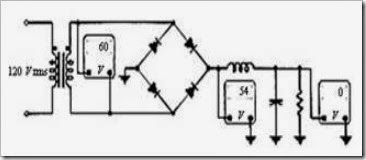
MCQs in Diode Applications Fig. 01

Figure 2-1

  • A) one of the diodes is open.
  • B) a diode is shorted.
  • C) an open transformer secondary.
  • D) the filter capacitor is shorted.
  • E) no trouble exists.

8. Refer to Figure 2-1. If the voltmeter across the transformer reads 0 V, the probable trouble, if any, would be

  • A) one of the diodes is open.
  • B) a diode is shorted.
  • C) an open transformer secondary.
  • D) the filter capacitor is shorted.
  • E) no trouble exists.

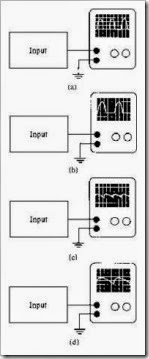
9. Refer to Figure 2-2. Which oscilloscope trace indicates the output from a properly operating half-wave rectifier without a filter?
MCQs in Diode Applications Fig. 02

Figure 2-2.

Assume that each scope has the same settings

  • A) a
  • B) b
  • C) c
  • D) d

10. Refer to Figure 2-2. Which oscilloscope trace indicates the output from a properly operating full-wave rectifier with a filter?

  • A) a
  • B) b
  • C) c
  • D) d

11. Refer to Figure 2-2. Which oscilloscope trace indicates the output from a full-wave filtered rectifier with an open diode?

  • A) a
  • B) b
  • C) c
  • D) d

12. Refer to Figure 2-2. The oscilloscope trace in (b) could represent the output from

  • A) a full-wave rectifier (no filter) with an open diode.
  • B) a normal half-wave power supply.
  • C) a filtered full-wave rectifier with an open diode.
  • D) a full-wave rectifier with a shorted diode.

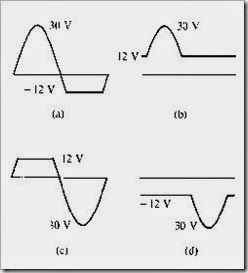
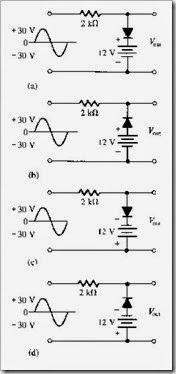
13. Refer to the circuit in Figure 2-3(a). Refer to the output waveforms shown in Figure 2-4 and select the correct approximate output waveform.
MCQs in Diode Applications Fig. 03

Figure 2-3

MCQs in Diode Applications Fig. 04

Figure 2-4

  • A) a
  • B) b
  • C) c
  • D) d

14. Refer to the circuit in Figure 2-3(b). Refer to the output waveforms shown in Figure 2-4 and select the correct approximate output waveform.

  • A) a
  • B) b
  • C) c
  • D) d

15. Refer to the circuit in Figure 2-3(c). Refer to the output waveforms shown in Figure 2-4 and select the correct approximate output waveform.

  • A) a
  • B) b
  • C) c
  • D) d

16. Refer to the circuit in Figure 2-3(d). Refer to the output waveforms shown in Figure 2-4 and select the correct approximate output waveform.

  • A) a
  • B) b
  • C) c
  • D) d

17. Refer to Figure 2-5. Which diode arrangement will supply a negative output voltage?
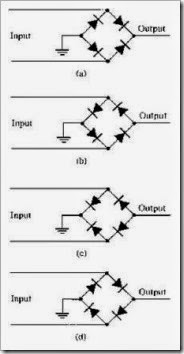
MCQs in Diode Applications Fig. 05

Figure 2-5

  • A) a
  • B) b
  • C) c
  • D) d

18. Refer to Figure 2-5. Which diode arrangement will supply a positive output voltage?

  • A) a
  • B) b
  • C) c
  • D) d

19. A silicon diode has a voltage to ground of –117 V from the anode. The voltage to ground from the cathode is –117.7 V. The diode is

  • A) open.
  • B) shorted.
  • C) forward-biased.
  • D) reverse-biased.

20. The output frequency of a half-wave rectifier is _____ the input frequency.

  • A) one-half
  • B) twice
  • C) equal to
  • D) none of the above

21. Each diode in a center-tapped full-wave rectifier is _____ -biased and conducts for _____ of the input cycle.

  • A) forward, 90º
  • B) reverse, 180º
  • C) forward, 180º
  • D) reverse, 90º

22. The output frequency of a full-wave rectifier is _____ the input frequency.

  • A) one-half
  • B) equal to
  • C) twice
  • D) one-quarter

23. What is the PIV for each diode in a full-wave center-tapped rectifier? Note: Vp(out) = peak output voltage.

  • A) Vp(out) – 0.7 V
  • B) Vp(out) + 0.7 V
  • C) 2Vp(out) – 0.7 V
  • D) 2Vp(out) + 0.7 V

24. In the operation of a half-wave rectifier with a capacitor-input filter, the ripple factor can be lowered by _____ the value of the filter capacitor or _____ the load resistors.

  • A) decreasing, decreasing
  • B) decreasing, increasing
  • C) increasing, decreasing
  • D) increasing, increasing

25. What type of diode circuit is used to clip off portions of signal voltages above or below certain levels?

  • A) clipper or limiter
  • B) clamper
  • C) IC voltage regulator
  • D) none of the above

26. What type of diode circuit is used to add or restore a dc level to an electrical signal?

  • A) clipper or limiter
  • B) clamper
  • C) IC voltage regulator
  • D) none of the above

27. What is the VRRM (PIV rating) for the 1N4001 rectifier diode?

  • A) 50 V
  • B) 100 V
  • C) 200 V
  • D) 400 V
  • E) none of the above

28. How many terminals do the 7800 series fixed positive voltage regulators have?

  • A) 2
  • B) 3
  • C) 4
  • D) 5
  • E) none of the above

Back to Homepage

Note: Check your works. Diode Applications - MCQs Answers


credit: Thomas L. Floyd©2013 www.FroydWess.com

Read More »

Introduction to Semiconductors - MCQs Answers

0 comments Posted by Anonymous at 2:23 PM
Hits:
Answers key for  Introduction to Semiconductors
Below are the answers key for the Multiple Choice Questions (Quiz) in Introduction to Semiconductors .

1. All of the above

2. 2n2 where n is the number of the shell.

3. has pentavalent impurity atoms added.

4. positive supply

5. anode

6. the value of dc voltages for the device to operate properly.

7. that impurities are added to decrease the resistance of the material.

8. 0.7 V.

9. a germanium diode.

10. cathode, anode

11. current.

12. 2.3 V, 1.6 V

13. reverse leakage current.

14. a pn junction.

15. is subjected to a large reverse voltage.

16. is relatively constant.

17. A material with few free electrons.

18. decreases.

19. the diode is internally shorted.

20. 4

21. 8

22. recombination

23. pentavalent

24. all of the above

25. forward-biased.

26. increased, increases

27. decreases

28. open, short

29. open

Back to Homepage


credit: Thomas L. Floyd©2013 www.FroydWess.com

Read More »

Introduction to Semiconductors - MCQs

0 comments Posted by Anonymous at 2:15 PM
Hits:
MCQs for Introduction to Semiconductors

Multiple Choice Questions Topic Outline

  • MCQs in Atom
  • MCQs in Materials Used in Electronics
  • MCQs in Current in Semiconductors
  • MCQs in N-Type and P-Type Semiconductors
  • MCQs in The PN Junction
  • MCQs in GreenTech Application 1: Solar Power

Begin and Good luck!

1. An atom is made up of

  • A) protons.
  • B) neutrons.
  • C) electrons.
  • D) all of the above

2. The maximum number of electrons in each shell of an atom is

  • A) 2.
  • B) 2n2 where n is the number of the shell.
  • C) 4.
  • D) 8.

3. An n-type semiconductor material

  • A) is intrinsic.
  • B) has trivalent impurity atoms added.
  • C) has pentavalent impurity atoms added.
  • D) requires no doping.

4. A diode conducts when it is forward-biased, and the anode is connected to the __________ through a limiting resistor.

  • A) positive supply
  • B) negative supply
  • C) cathode
  • D) anode

5. The wide end arrow on a schematic indicates the __________ of a diode.

  • A) ground
  • B) direction of electron flow
  • C) cathode
  • D) anode

6. The term bias in electronics usually means

  • A) the value of ac voltage in the signal.
  • B) the condition of current through a pn junction.
  • C) the value of dc voltages for the device to operate properly.
  • D) the status of the diode.

7. Doping of a semiconductor material means

  • A) that a glue-type substance is added to hold the material together.
  • B) that impurities are added to increase the resistance of the material.
  • C) that impurities are added to decrease the resistance of the material.
  • D) that all impurities are removed to get pure silicon.

8. The forward voltage across a conducting silicon diode is about

  • A) 0.3 V.
  • B) 1.7 V.
  • C) –0.7 V.
  • D) 0.7 V.

9. You have an unknown type of diode in a circuit. You measure the voltage across it and find it to be 0.3 V. The diode might be

  • A) a silicon diode.
  • B) a germanium diode.
  • C) a forward-biased silicon diode.
  • D) a reverse-biased germanium diode.

10. A reverse-biased diode has the _____ connected to the positive side of the source, and the _____ connected to the negative side of the source.

  • A) cathode, anode
  • B) cathode, base
  • C) base, anode
  • D) anode, cathode

11. The movement of free electrons in a conductor is called

  • A) voltage.
  • B) current.
  • C) recombination.
  • D) equilibrium.

12. A silicon diode is forward-biased. You measure the voltage to ground from the anode at _____, and the voltage from the cathode to ground at _____.

  • A) 0 V, 0.3 V
  • B) 2.3 V, 1.6 V
  • C) 1.6 V, 2.3 V
  • D) 0.3 V, 0 V

13. There is a small amount of current across the barrier of a reverse-biased diode. This current is called

  • A) forward-bias current.
  • B) reverse breakdown current.
  • C) conventional current.
  • D) reverse leakage current.

14. The boundary between p-type material and n-type material is called

  • A) a diode.
  • B) a reverse-biased diode.
  • C) a pn junction.
  • D) a forward-biased diode.

15. Reverse breakdown is a condition in which a diode

  • A) is subjected to a large reverse voltage.
  • B) is reverse-biased and there is a small leakage current.
  • C) has no current flowing at all.
  • D) is heated up by large amounts of current in the forward direction.

16. As the forward current through a silicon diode increases, the voltage across the diode

  • A) increases to a 0.7 V maximum.
  • B) decreases.
  • C) is relatively constant.
  • D) decreases and then increases.

17. Which statement best describes an insulator?

  • A) A material with many free electrons.
  • B) A material doped to have some free electrons.
  • C) A material with few free electrons.
  • D) No description fits.

18. As the forward current through a silicon diode increases, the internal resistance

  • A) increases.
  • B) decreases.
  • C) remains the same.

19. A silicon diode measures a low value of resistance with the meter leads in both positions. The trouble, if any, is

  • A) the diode is open.
  • B) the diode is shorted to ground.
  • C) the diode is internally shorted.
  • D) the diode is working correctly.

20. Single-element semiconductors are characterized by atoms with ____ valence electrons.

  • A) 3
  • B) 4
  • C) 5
  • D) 2

21. Effectively, how many valence electrons are there in each atom within a silicon crystal?

  • A) 2
  • B) 4
  • C) 8
  • D) 16

22. What occurs when a conduction-band electron loses energy and falls back into a hole in the valence band?

  • A) doping
  • B) recombination
  • C) generation
  • D) none of the above

23. What types of impurity atoms are added to increase the number of conduction-band electrons in intrinsic silicon?

  • A) bivalent
  • B) octavalent
  • C) pentavalent
  • D) trivalent
  • E) none of the above

24. What factor(s) do(es) the barrier potential of a pn junction depend on?

  • A) type of semiconductive material
  • B) the amount of doping
  • C) the temperature
  • D) all of the above

25. Under normal conditions a diode conducts current when it is

  • A) reverse-biased.
  • B) forward-biased.
  • C) avalanched.
  • D) saturated.

26. For a forward-biased diode, as temperature is _____, the forward current _____ for a given value of forward voltage.

  • A) decreased, increases
  • B) increased, increases
  • C) increased, decreases
  • D) decreased, decreases

27. For a forward-biased diode, the barrier potential _____ as temperature increases.

  • A) decreases
  • B) remains constant
  • C) increases

28. An ideal diode presents a(n) _____ when reversed-biased and a(n) _____ when forward-biased.

  • A) open, short
  • B) short, open
  • C) open, open
  • D) short, short

29. The most common type of diode failure is a(n) _____.

  • A) open
  • B) short
  • C) resistive

Back to Homepage

Note: Check your works. Introduction to Semiconductors - MCQs Answers


credit: Thomas L. Floyd©2013 www.FroydWess.com

Read More »

Multiple Choice Questions in Floyd's Electronic Devices

0 comments Posted by Anonymous at 1:29 PM
Hits:
Multiple Choice Questions in Floyd's Electronic Devices

You are here because you are looking for the complete set of Multiple Choice Questions for Floyd's Electronic Devices and this is your lucky day. Below are the compilation of all the quizzes (mcqs) and fill-in-the-blanks questions for each and every chapters in the book of  Electronic Devices - Electron Flow Version and Conventional Current Version 8th Edition by Thomas L. Floyd.

The books are divided in eighteen chapters .

note: ADDING MCQs ON-PROGRESS . . .

Content Chapters MCQs

Content Chapters Answers key

NOTE:

For any Questions, Clarifications and any violent Reactions use the comment section below. I'll be much willing to assist you.


credit: Thomas L. Floyd©2013 www.FroydWess.com

Read More »
 

© 2013 - 2014. All Rights Reserved | Online Notes and Lectures | Customized by MovieOnMovie

Home | | | Top ▲